By Reportorial Team
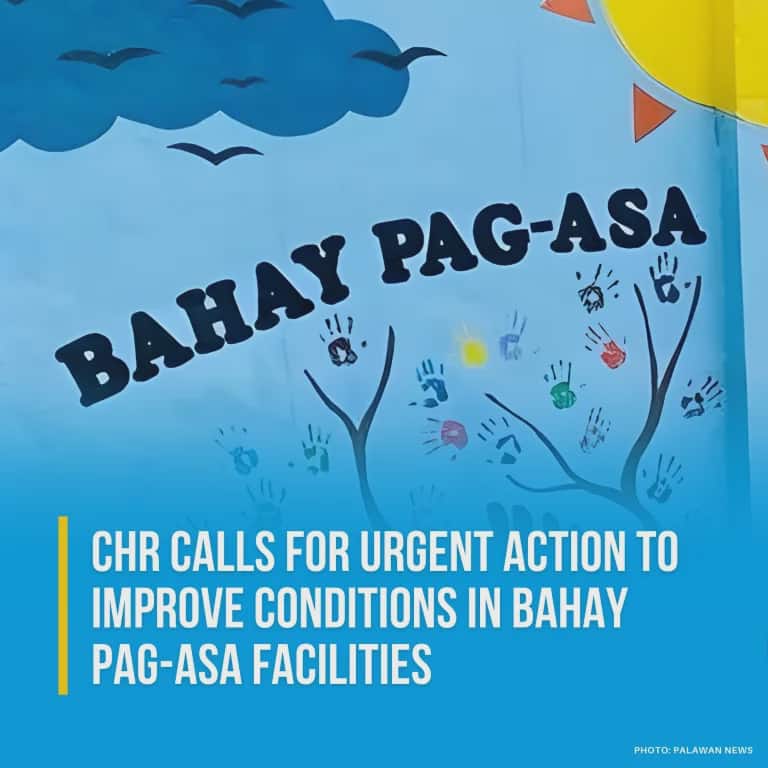
The Commission on Human Rights (CHR) calls for urgent action to address poor conditions and child protection gaps in several Bahay Pag-asa (BPA) facilities across the country.
This follows the CHR’s release of a situation report detailing the findings of its nationwide monitoring of BPA facilities.
The CHR documented serious issues in the implementation of the Juvenile Justice and Welfare Act, or Republic Act (RA) No. 9344.
These include violence during a child’s apprehension, ill-treatment by facility personnel, and facilities that are designed more like jails than safe spaces for children.
The report also identifies major concerns affecting the welfare of children in these facilities. These include poor living conditions, delay in the disposition of cases, limited access to healthcare and education, strict or limited visitation rules that affect family contact, and shortages in staff and resources.
These conditions violate not only RA 9344 but also Article XV of the 1987 Philippine Constitution, which requires the State to ensure that children receive proper care, nutrition, and protection from abuse and neglect.
These findings are likewise inconsistent with the UN Convention on the Rights of the Child (UNCRC), to which the Philippines is a State Party.
Children in Conflict with the Law (CICL) are too often treated as criminals during arrest and detention, with some reporting physical abuse by authorities.
Article 40 of the UNCRC states that children must be treated in a manner consistent with their dignity and worth.
In response, the Commission recommends practical and immediate steps to improve the juvenile justice system. These include adopting child-sensitive visitation policies and standards, hiring social workers and specialists, and ensuring adequate funding and support for BPA facilities.
The CHR also stresses the need to strictly comply with child-friendly standards in all facilities, improve sanitation, provide regular training for personnel, completely prohibit violence, and strengthen accountability mechanisms for violators.
The Commission emphasizes that treating CICLs in a harsh and dehumanising manner deepens stigma and makes it harder for them to change and rebuild their lives. Instead, they should be recognised as children who often need support, care, and guidance.
The CHR urges the State and all duty-bearers to invest in safe and supportive environments where children can recover, learn, and successfully reintegrate into society.