
By Lane Afable, News Editor
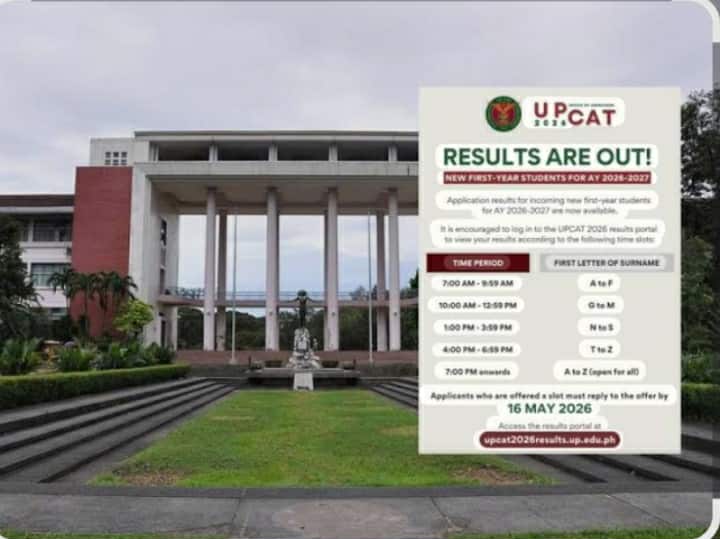
Out of 147,437 applicants, 18,350 have qualified for admission to the University of the Philippines via the UP College Admission Test for Academic Year 2026–2027.
Successful examinees, including both degree program qualifiers and those on the waitlist, have received admission notices from the UP Office of Admissions on April 22; they comprise 12.44% of the total number of applicants for the coming academic year.
UPCAT 2026, administered August 2025 in 117 testing centers nationwide, posted a higher number of applicants and qualifiers than UPCAT 2025, where there were 17,996 successful examinees out of 135,236 applicants.
UP President Angelo Jimenez said that the higher number of UPCAT takers this year is “an indication that more families continue to look to UP as a place where their children’s potential can grow.”
UP Vice President for Public Affairs Marian Coquia-Regidor welcomes the members of the media who are attending the 22 April UPCAT 2026 press briefing—both in person at the UP Executive House and online via Zoom. Photo by Jun Madrid, UPS-MCO.
The percentage of qualifiers from public schools also notably climbed up to 57.1% from the previous 55%—continuing a trend of more public-school qualifiers in the UPCAT since 2023.
While UP Diliman (UPD) continues to receive the largest share of qualifiers at 32.4%, more than 6,701 or 36.52% of this year’s qualifiers received admission notices to campuses outside UPD, UP Los Baños, and UP Manila.
This marks an increase from last year’s 34.8% or over 6,200 students, which, according to Jimenez, “reflects continuing efforts to strengthen the entire UP System and to encourage students to consider the full range of academic opportunities” across UP’s constituent universities.
This year’s results also saw more qualifiers coming from more regions and provinces. Qualifiers from indigenous communities, which comprise 439 or 2.4% of the total number of qualifiers, also increased by 16% from last year.
The Cordillera Administrative Region had 78 qualifiers, while the Bangsamoro Autonomous Region in Muslim Mindanao had 59.
“These trends suggest that the steps we have taken to expand and democratize access to quality UP education are beginning to make an impact in meaningful ways,” Jimenez stated.
About 21.45% of the qualifiers for the upcoming academic year also came from households with a gross annual income of 200,000 pesos or less.
Among the 2026 qualifiers are 2,323 first-generation college students.
After the UPCAT 2026 press briefing, UP President Jimenez is interviewed by members of the press. Photo by Jun Madrid, UPS-MCO.
Jimenez emphasized that strengthened support systems are readily available for students whose costs of staying in school remain a challenge despite free tertiary education—among them, the Lingap Iskolar Program for qualifiers from unserved and underserved communities, the Living Expenses Allowance Program (LEAP), as well as existing national and university-based support mechanisms.
“We are aware that much still remains to be done, but our direction is clearer than ever before. We are seeing steady movement toward a university that is not only excellent, but also more representative, more inclusive, more responsive, and more open to those who have the capacity and the desire to succeed,” he stated.