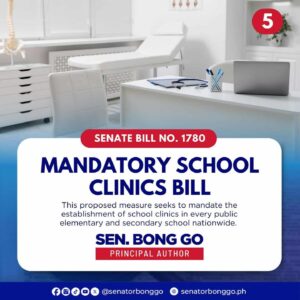

Senator Christopher “Bong” Go is pushing for the institutionalization of school clinics in all public elementary and secondary schools nationwide, citing serious gaps in the availability of on-site health facilities and personnel that directly affect students’ well-being and learning conditions.
Through Senate Bill No. 1780, Go underscores that access to basic healthcare within schools remains uneven and inadequate, particularly in rural and geographically isolated areas, and argues that education outcomes are inseparable from the health status of learners.
“Data from the Department of Education showed that only 28% or about 13,081 schools out of 47,013 public schools nationwide have school clinics,” he stated, warning that this situation leaves many students without immediate access to basic medical attention during school hours.
Go described this shortfall as a serious weakness in the delivery of youth-focused health services, particularly within the educational setting where children spend most of their day. He noted that while the Department of Education (DepEd) has articulated an objective of ensuring at least one functional clinic or health corner in every public school, the reality on the ground remains far from that target.
According to him, “many still lack proper health facilities, medical equipment, or full-time health personnel, especially in rural and remote areas.”
The senator emphasized that SBN 1780 directly responds to this gap by mandating the establishment of a school clinic in every public elementary and secondary school across the country. He explained that the intent of the measure is not merely administrative compliance but a recognition of the relationship between student health and educational quality.
Central to the bill’s rationale is the idea that health is a prerequisite for meaningful learning. Go made this clear in his explanatory note, stating that “by institutionalizing school clinics, the State recognizes that quality education cannot be achieved without healthy learners.”
Under the measure, all public elementary and secondary schools operated by the DepEd are required to have a functional school clinic. Existing clinics are to be assessed and, if necessary, upgraded or expanded to meet the standards set by the proposed law. These clinics are envisioned to provide basic medical, dental, and first-aid services to students, teachers, and school personnel, and to be equipped with adequate medical supplies and sanitation facilities.
The bill also specifies that each clinic should serve as the primary health service delivery unit within the school, covering first aid and emergency care, basic medical and nursing services, health screening and monitoring, health education, disease prevention programs, and nutrition assessment and counseling.
To ensure proper operation, clinics are to be manned by at least one school nurse or qualified health personnel, working under the supervision of DepEd and in coordination with the Department of Health (DOH) and concerned local government units.
Implementation of the construction and upgrading of school clinics is proposed to take place within five years from the law’s effectivity, with priority given to schools in geographically isolated and disadvantaged areas, schools without existing clinics, schools located in high-risk disaster zones, and schools with large student populations.
The measure assigns joint responsibility to several agencies, with DepEd overseeing planning and integration, the Department of Public Works and Highways serving as the lead agency for design and construction, local government units providing possible counterpart support, and the DOH setting standards for clinic layout and medical functionality.