
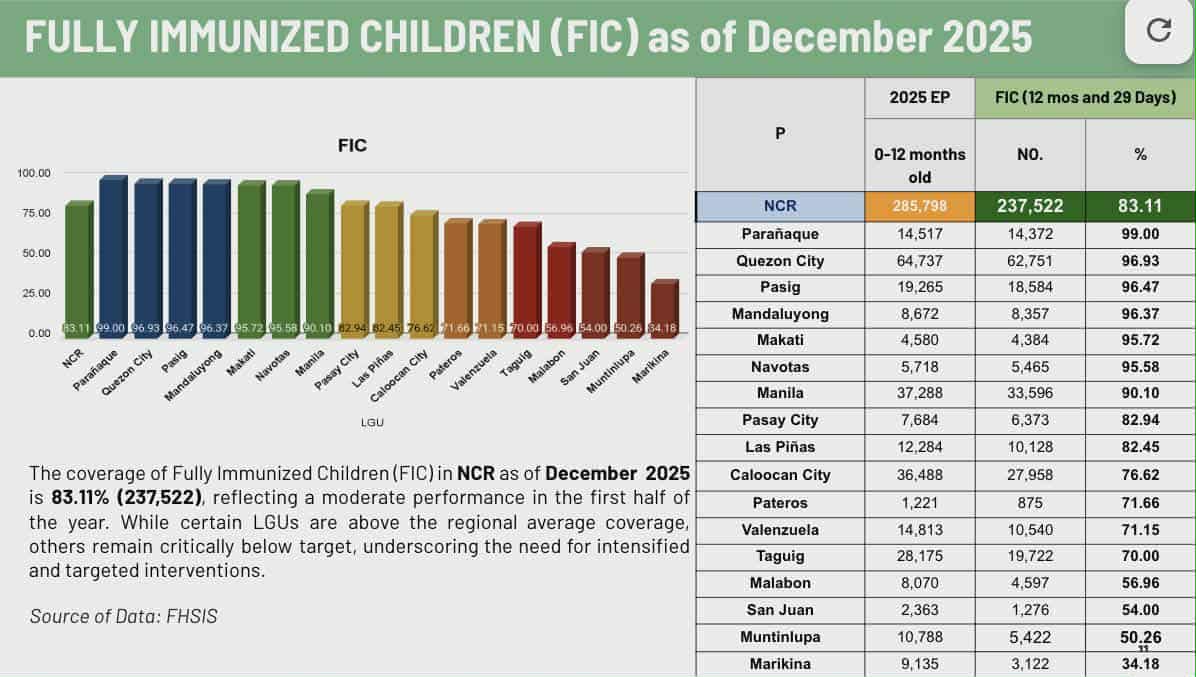
Parañaque City has secured the top spot in Metro Manila for childhood immunization, achieving a 99% coverage rate, as the National Capital Region (NCR) shows moderate progress in vaccinating its youngest residents, according to the latest official health data.
Data from the Department of Health’s (DOH) Field Health Services Information System (FHSIS) reveals that as of December 2025, the region’s coverage for Fully Immunized Children (FIC) reached 83.11%.
FHSIS is a nationwide facility-based recording and reporting system used by the Department of Health (DOH) and LGUs as a key reference for planning, managing, and implementing public health programs.
Data from FHSIS in Metro Manila showed a total of 237,522 out of 285,798 infants, aged zero to 12 months across NCR, completed their routine immunizations. This reflects a moderate regional progression in the vaccination campaign efforts, compared to the previous year, when only 61% or 1,459,353 out of 2,392,392 eligible children nationwide were considered fully immunized.
Parañaque City emerged as the clear leader, successfully immunizing 237,522 out of 14,517 infants in the city against preventable diseases.
Parañaque is followed by Quezon City (96.93%), Pasig (96.47%), Mandaluyong (96.37%), Makati (95.72%), and Navotas (95.58%).
The leading cities, including Parañaque, Quezon City, and Pasig, did not achieve their high marks by accident. The FHSIS report credits their success to the implementation of strong local health systems, effective barangay-level awareness campaigns, and sustained efforts to engage parents and caregivers.
These programs ensure that communities understand the importance of vaccines and that services are accessible.
Manila, the region’s most populous city, posted a 90.10 percent immunization coverage—above the NCR average but still short of the goal of universal immunization.
Meanwhile, several LGUs lagged significantly behind, raising concerns among public health officials about heightened vulnerability to vaccine-preventable diseases.
Marikina recorded the lowest coverage at 34.18%, followed by Muntinlupa (50.26%), San Juan (54.0%), Malabon (56.96%), Taguig (70.0%), Valenzuela (71.15%), and Pateros (71.66%).
“While certain LGUs are above the regional average coverage, others remain critically below target, underscoring the need for intensified and targeted interventions,” the FHSIS report read.
Multiple factors contribute to the immunization gaps, including high population mobility, vaccine hesitancy, access and logistical challenges, and issues with data reporting and tracking of children who miss scheduled vaccinations.
The Parañaque City government continues targeted interventions in low-performing areas within its jurisdiction through catch-up drives and better monitoring.
These include strengthened barangay-based education campaigns, catch-up immunization drives, and improved monitoring systems to ensure no child is left unvaccinated.
The DOH earlier announced that coordinated efforts with NCR LGUs will be ramped up in early 2026 to boost immunization coverage, emphasizing that full vaccination within a child’s first year of life is critical to preventing outbreaks of measles, polio, diphtheria, and other vaccine-preventable diseases.
Noting the increase in measles-rubella cases, the DOH aims to immunize more than 10 million children nationwide this year.
Measles is a highly contagious disease, with a single infected person capable of transmitting the virus to an estimated 12 to 18 others.