
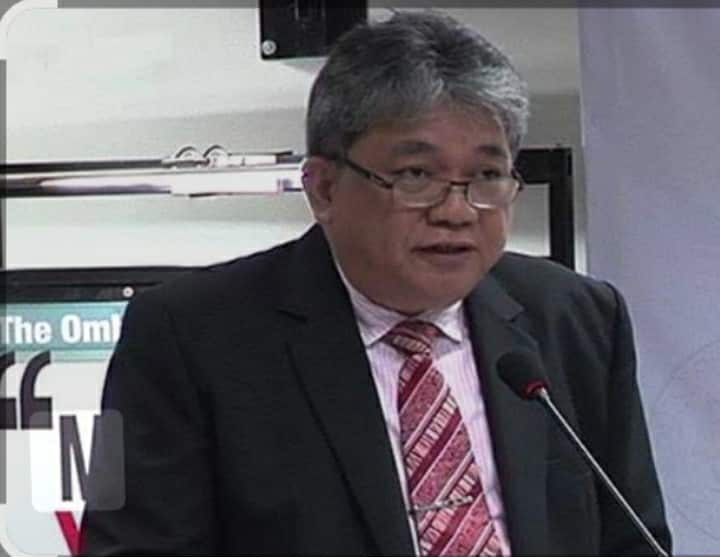
By Lane Afable, News Editor
The Supreme Court (SC) 3rd Division has voided the Malacañang order that fired the Overall Deputy Ombudsman (ODO) who handled the probe into former president Rodrigo Duterte’s wealth.
The 3rd Division, through the ruling penned by Associate Justice Maria Filomena Singh, also voided the June 14, 2019 Office of the Ombudsman decision that ordered Melchor Arthur Carandang to cease from serving as ODO and declared his post vacant.
On top of these, the SC Third Division also ruled that Carandang is entitled to all retirement benefits effective until his term’s expiration.
Duterte fired Carandang in 2018, but the latter was supposed to retire in 2020.
“He is likewise entitled to receive the salaries corresponding to the period of his preventive suspension and dismissal, but only up to the end of his term,” the High Court added.
The rest of the Third Division justices — associate justices Alfredo Benjamin Caguioa (chairperson), Henri Jean Paul Inting, Samuel Gaerlan, and Japar Dimaampao — all concurred in the ruling.
Duterte’s Office of the President (OP) fired Carandang after he was found liable for graft and corruption and betrayal of public trust, in an order dated July 30, 2018.
The dismissal’s ground was alleged breach of confidentiality and graft when Carandang made statements on the bank investigation into Duterte’s wealth.
Since the Office of the Ombudsman is an independent constitutional body, the question back then was whether Duterte had the power to dismiss Carandang.
But when Duterte appointee Samuel Martires became the Ombudsman in 2019, Martires said he had no choice but to dismiss Carandang.
Carandang’s case reached the SC for review because the Court of Appeals granted the former ODO’s petition in 2021, voiding the OP’s order and dismissing the complaints against him.
The Duterte-time OP sought a reconsideration, but it was denied.
Marcos-time OP, through the Office of the Solicitor General, then filed a petition with the SC to challenge the CA ruling.
In the ruling, the SC said the president — in this case, Duterte — has no administrative or disciplinary powers over a deputy ombudsman.
“It would be nothing short of a constitutional paradox, and a direct affront to accountability, if former president Duterte were allowed to sanction Carandang, one of the remaining officials explicitly empowered to hold government actors to account,” the High Court explained.
“With [Conchita] Carpio-Morales recused and Carandang removed, the Office of the Ombudsman was left virtually headless with even fewer individuals willing or able to enforce accountability in government, the president, in particular.
Surely, this was the very evil the Constitution sought to guard against,” it added.
Even in the hypothetical situation that the OP has disciplinary authority over the former ODO, the SC said the claim against Carandang “rests on tenuous grounds.”
The complaint against Carandang stemmed from his media interview, where he mentioned allegedly anomalous bank transaction records related to the former president.
This was in light of former senator Antonio Trillanes IV’s complaint with the Ombudsman concerning Duterte’s alleged unexplained assets.
For the SC, Carandang’s issuance of the said statements did not constitute administrative liability to justify his dismissal from service.
The SC said they “more closely resemble observations” of an official whose job was to investigate public officials, like the president.
“This highlights the very reason constitutional and statutory limits on presidential authority exist: to safeguard the rule of law and prevent the concentration of unchecked power,” the SC said.
“Allowing the president to unilaterally discipline officials charged with investigating potential wrongdoing within the administration invites retaliation, coercion, and the suppression of oversight, conditions fundamentally at odds with transparency and accountability.”