
By Lane Afable, News Editor
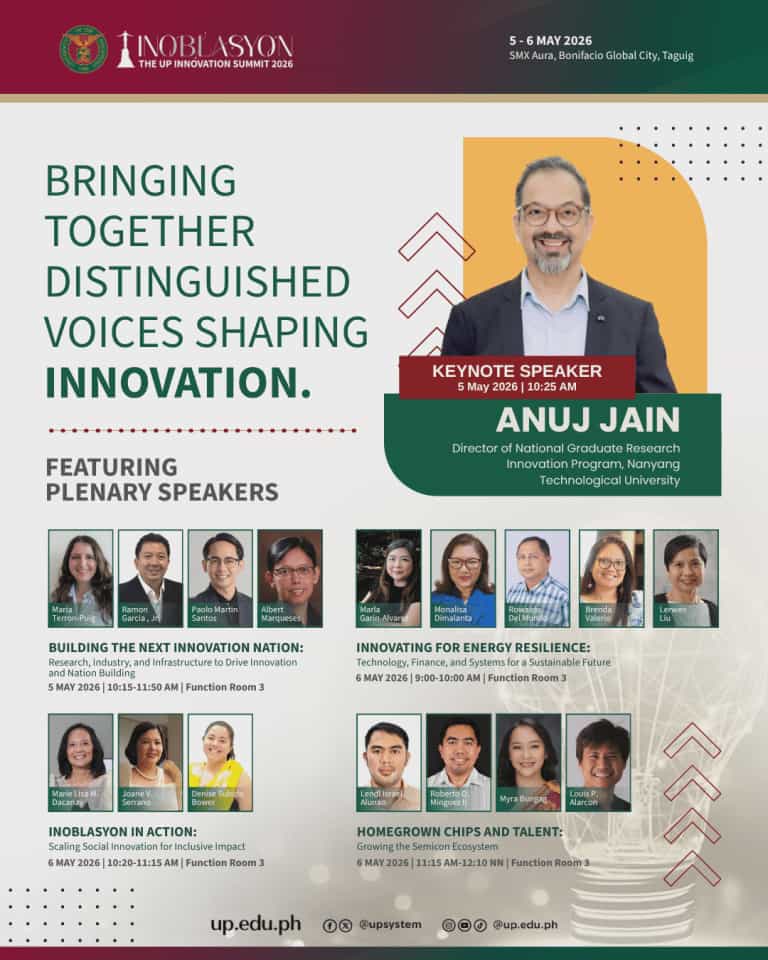
The University of the Philippines’ first innovation summit opens May 5 at the SMX Convention Center Aura in Bonifacio Global City, bringing together leaders from industry, government, and academia.
Dubbed “Inoblasyon: The UP Innovation Summit 2026”, the two-day event will highlight partnerships among researchers, inventors, industry, government agencies, investors, and community partners that are vital to strengthening UP’s innovation ecosystem.
Inoblasyon — fusing the words “innovation” and “oblation” — captures UP’s vision of innovation as a “purpose-driven contribution and commitment to serve society, one that bridges gaps, uplifts communities, strengthens industries, and advances collective progress,” explained Joel Marciano Jr., UP Vice President for Research and Innovation.
This year’s event seeks to cultivate meaningful dialogue and multi-stakeholder engagement to advance emerging innovation clusters. Ultimately, it aims to forge enduring partnerships that drive evidence-based, impact-driven initiatives for nation-building.
Anuj Jain, director of the National Graduate Research Innovation Programme and Activate Global Fellows Singapore at Nanyang Technological University, will deliver the summit’s keynote speech. As the head of NTU GRIP, he leads national platforms that enable scientists and researchers across Singapore’s universities and research institutes to build companies from IP-rich discoveries. With 25 years of commercial leadership experience across the Asia-Pacific, his work bridges academia, capital, and industry, with a particular focus on closing the “lab-to-market” gap in deep-tech innovation.
The morning sessions will include a panel on energy resilience and the Philippines’ transition to low-carbon, inclusive energy systems, followed by a discussion on social entrepreneurship and inclusive innovation. The closing panel will examine UP-industry partnerships, including chip design collaborations and opportunities for talent development, research and development, and integration into the global supply chain.
Afternoon sessions will feature knowledge exchange discussions and UP-developed technologies, startups, and research in eight innovation clusters: health, biotech and biomedical systems; agri-aqua biotechnology and smart food systems; functional foods and nutraceuticals, climate; energy and environmental technologies; sustainable materials, circular economy and green manufacturing; creative industries and cultural enterprises; digital governance and public-sector innovation; and digital technology innovations in the education and legal sectors.